
The Mapping Violence in North Korea project compares the logics behind different forms of authoritarian repression by examining regime-perpetrated violence in the Democratic People’s Republic of Korea.
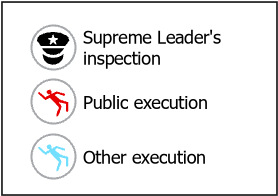
As a starting point, I plot executions across time and space, using data compiled by NKDB (North Korean Human Rights Database). The Seoul-based non-governmental organisation has one of the most extensive collections of qualitative data about human rights abuses inside the secretive regime, gathered through defector testimonies and publicly available information (such as published biographies). In a working paper titled “Violent Repression as Fire-alarms? Executions and On-the-spot Guidance in North Korea”, I argue that, in a regime characterised by chronic information-asymmetries, violent repression can serve as a signal of problematic local governance, prompting direct interventions from the centre. Using spatiotemporal data, I find that the executions – and particularly public executions – are highly correlated with inspections from the ‘Supreme Leader’ himself in the following year. Interviews with 13 former North Korean coercive agents add nuanced support to this argument.
The next stage of this project aims to map other forms of violent repression at even more granular spatial and temporal units. Despite the impressive collection of qualitative data by various government and non-government organisations, there have been few attempts to analyse North Korea’s violence quantitatively, even though spatial analysis has the potential to offer unique insights – especially in combination with remote sensing techniques (Son 2022). To reach this potential, the project (with Rebecca Cordell) will develop AI tools that can efficiently transform vast amounts of qualitative materials to detailed event-level data. Once we map the various types of repression reported by defectors, we will not only become able to understand the logics behind each form of repression but examine how each type of repression interacts with one another.
 Seunghoon Chae